
You walked out of the shop with a piece of art on your skin — and a strip of plastic wrap, a few rushed instructions, and a vague sense that what you do over the next month will decide whether your tattoo stays sharp or goes soft and patchy. The artist did their part. The healing part is on you, and the single biggest variable is the lotion you reach for.
Here’s the thing most aftercare guides skip: there’s no one product that works for the entire process. The first few days demand something protective and occlusive. Once peeling starts, that same product becomes too heavy and you need to switch to a lightweight lotion. Once the tattoo is healed, you need a daily moisturizer to keep the ink looking saturated for years — and a sunscreen, because UV is what fades color faster than anything else.
We pulled together nine of the best lotions for tattoo healing and care, looked at what’s actually in them, who they work for, and where each one fits in your healing timeline. Whether you’re searching for the best moisturizer for tattoo healing, a gentle tattoo lotion for new tattoos, or the best lotion for tattoo care that you can use for life, there’s something here for every stage and every skin type.
In This Guide
- Aquaphor Healing Ointment — Best for the First Few Days
- After Inked Tattoo Aftercare Lotion — Best Overall
- Mad Rabbit Tattoo Balm & Aftercare Cream — Best for Reviving Old Tattoos
- Mad Rabbit Soothing Gel — Best for Itch & Irritation
- Tattoo Goo Original Aftercare Balm — Best Petroleum-Free Salve
- Lubriderm Daily Moisture + Pro-Ceramide — Best Drugstore Lotion
- Harry’s Tattoo Frost — Best Daily Aftercare Gel
- Kiehl’s Creme de Corps — Best Premium Body Lotion
- Jack Black Oil-Free Sun Guard SPF 45 — Best Sunscreen for Tattoos
- Comparison Table
- Buyer’s Guide
- FAQ
Ointment vs. lotion vs. balm — what’s the difference? Ointments are thick, petroleum- or wax-based, and form an occlusive seal — perfect for the first 2–5 days when your tattoo is technically an open wound. Lotions are water-based, breathable, and right for the peeling and post-peel phases. Balms sit somewhere in between: heavier than a lotion, lighter than an ointment, usually plant-based, and built to be used long after healing to keep ink saturated. A complete aftercare kit usually includes at least one of each.
Aquaphor Tattoo Healing Ointment

Aquaphor Healing Ointment, Advanced Therapy Skin Protectant, 14 Oz Jar
View on AmazonIf you ask ten tattoo artists what to use the night you get inked, at least seven will say Aquaphor. There’s a reason it’s the default: it’s a 41% petrolatum ointment cut with mineral oil, glycerin, panthenol (provitamin B5), and bisabolol — semi-occlusive enough to seal moisture in and bacteria out, but breathable enough that the skin doesn’t suffocate the way it does under straight Vaseline.
The healing logic is simple. Fresh tattoos weep plasma and ink for the first 24–48 hours, then the surface starts to dry and tighten. Aquaphor’s barrier keeps the wound moist enough to scab thinly rather than crust thick, which is what actually preserves linework and color saturation. The panthenol pulls double duty as a skin-repair agent, and the glycerin draws water from deeper layers up to the surface.
The catch — and it’s a real one — is that Aquaphor is too heavy to use for the entire heal. After day three to five, you want to switch to a thinner lotion so the skin can shed and breathe. Use it like an ointment, not a daily moisturizer: thin layer, two to three times a day, only for the first week or so.
What We Like
- Dermatologist-recommended and widely available
- Semi-occlusive — protects without fully suffocating
- Panthenol supports skin repair
- Big 14 oz jar is great value
Worth Noting
- Petroleum-based, which not everyone wants on broken skin
- Too heavy for extended use — switch to lotion by day 5
- Contains lanolin (skip if you have a wool allergy)
- Greasy texture can stain sheets
After Inked Tattoo Aftercare Lotion
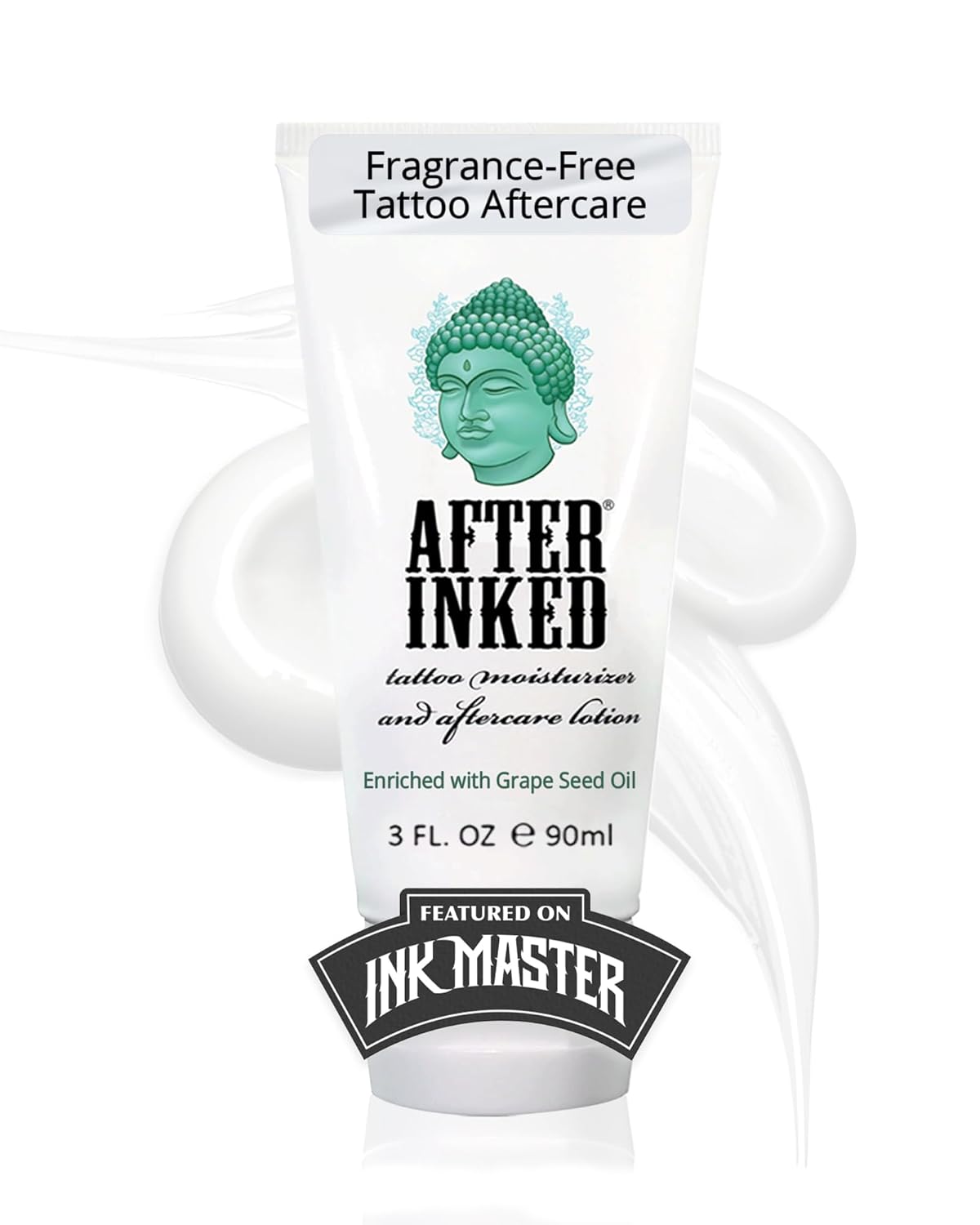
After Inked Tattoo Aftercare Lotion Moisturizing Balm, Featured on Ink Master, with Grape Seed Oil, 3oz Tube
View on AmazonIf you want a single product that bridges the gap between “fresh wound” and “long-term maintenance,” After Inked is hard to beat. It’s the rare tattoo lotion that’s been formally adopted by working pros — it’s the official aftercare lotion of TV’s Ink Master, and Miami Ink’s Ami James is among the artists who’ve put their name on it — but the formula itself is what earns the spot.
The hero ingredient is grape seed oil. It’s lightweight, antioxidant-rich, and non-comedogenic, which means it hydrates the skin without clogging pores or weighing down the healing surface. The rest of the ingredient list reads cleanly: water, glycerin, shea butter, jojoba seed oil, a small amount of orange oil, and a natural preservative system. No petroleum, no parabens, no synthetic fragrance, no gluten — and the formula is vegan and patented for reducing trans-epidermal water loss (TEWL).
What that translates to in real use: the lotion absorbs in seconds, doesn’t leave a greasy film, doesn’t stain clothes or sheets, and keeps your skin saturated long enough that you only need to reapply two or three times a day. You can use it from the moment your tattoo stops weeping all the way through the peeling phase, then keep using it indefinitely as a maintenance moisturizer for old ink. The 3 oz tube is travel-friendly, and many users keep it refrigerated for an added cooling effect when applying.
What We Like
- Patented formula clinically reduces water loss from skin
- Genuinely non-greasy — doesn’t stain fabric
- Vegan, paraben-free, fragrance-free, gluten-free
- Endorsed by working tattoo professionals
Worth Noting
- 3 oz tube goes fast on larger pieces
- The “no scent” is plain — not pleasant, just neutral
- Manufacturer specifies not combining with other products
- Cap can pop open in a bag
Mad Rabbit Tattoo Balm & Aftercare Cream

Mad Rabbit Tattoo Balm & Aftercare Cream — Color Enhancement, Petroleum Free, Daily Tattoo Moisturizer
View on AmazonMad Rabbit launched out of a college dorm room in 2019, landed a deal on Shark Tank, and has since become one of the most-Instagrammed tattoo aftercare brands on the market. The original Tattoo Balm is still its flagship — and unlike most of the heavier options on this list, it’s not designed for the first few days. It’s built for life after healing, which is when most people stop caring for their ink and let it slowly dull.
The formula is anhydrous (water-free) and plant-based: shea butter, cocoa butter, beeswax, sweet almond oil, calendula oil, and a rotating cast of essential oils for scent (lavender, frankincense, sandalwood, vanilla coconut, or a newer unscented version). There’s no petrolatum, no mineral oil, no parabens. The texture is closer to a body butter than a lotion — you scoop a small amount, warm it between your fingers, and massage it into the tattoo until it disappears.
What you’ll notice immediately is the contrast boost. Cocoa butter and shea butter saturate dehydrated skin, and dehydrated skin is what makes old tattoos look gray and fuzzy around the edges. Use this two or three times a week on healed work and your blacks look blacker, your colors look deeper, and the lines look like they were drawn yesterday. Just don’t apply it to a brand-new tattoo — Mad Rabbit’s own guidance is to wait until the scabbing phase is fully done, usually around two to three weeks in.
What We Like
- Visibly enhances contrast and color depth on old ink
- Petroleum-, mineral-oil-, and paraben-free
- Pleasant essential-oil scents (or unscented option)
- A little goes a long way — tin lasts months
Worth Noting
- Not for use on fresh, unhealed tattoos
- Texture is thick — needs warming in hands first
- Contains nut-derived ingredients (shea, almond)
- Tin is small for the price tier
Mad Rabbit Tattoo Aftercare Soothing Gel
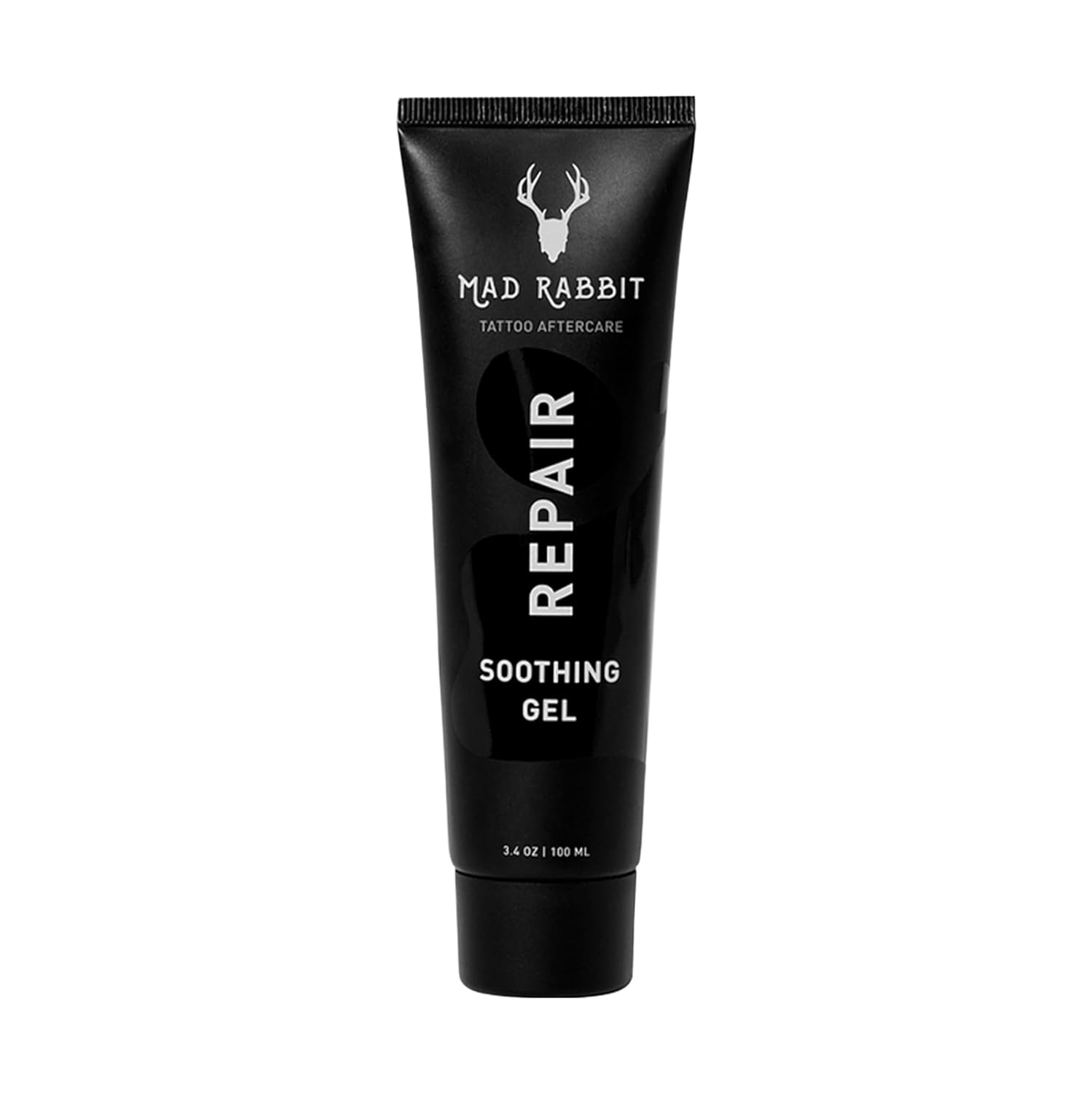
Mad Rabbit Tattoo Aftercare Soothing Gel & Moisturizer, As Seen on Shark Tank
View on AmazonThe single most miserable phase of healing a tattoo isn’t the day you got it. It’s day five through ten, when the surface tightens, starts to peel, and itches in a way that feels almost cruel — and you can’t scratch without pulling color out. Mad Rabbit’s Soothing Gel was built specifically for this window, and it works.
The formula skips occlusive bases entirely. Instead, it leans on aloe vera leaf juice, allantoin, panthenol, glycerin, sodium hyaluronate, and a long list of amino acids and lightweight botanical oils (sweet almond, linseed, avocado). The result is a clear, fast-absorbing gel that delivers a noticeable cooling sensation on contact — that cooling is doing real work, calming inflammation and dulling the itch signal long enough for the skin to keep peeling on its own schedule.
You can apply it as soon as you’ve washed and dried your fresh tattoo for the first time, and Mad Rabbit recommends using it daily for the first 14 days. It pairs cleanly with their Tattoo Balm — gel during the heal, balm once you’re fully healed. Because there’s no petroleum or mineral oil weighing the formula down, healing skin gets to breathe, which is what actually speeds up recovery.
What We Like
- Real cooling sensation — instant itch relief
- Goes on clear, absorbs in seconds, no greasy film
- Aloe + allantoin + panthenol is a proven calming trio
- Works on both new tattoos and general skin irritation
Worth Noting
- Not enough barrier protection for the very first 24 hours
- Won’t enhance color the way the balm does
- Best paired with another product, not used solo
- Premium tier pricing
Tattoo Goo Original Aftercare Balm

Tattoo Goo Tattoo Aftercare Balm, 0.75 oz Tin, Natural Olive Oil & Beeswax, No Petroleum
View on AmazonTattoo Goo has been around since 1995 — older than most of the artists working today — and it’s still one of the only legacy tattoo balms that has never used petroleum, lanolin, or mineral oil. The original salve is 98% natural ingredients: olive oil, beeswax, cocoa butter, wheat germ oil, vitamin E, lavender oil, sunflower oil, and rosemary extract, with a small amount of D&C Green 6 that gives the salve its signature pale-green tint.
Functionally it sits in the same lane as Aquaphor — protective enough for the first few days of healing — but with a fundamentally different ingredient philosophy. The beeswax forms the occlusive layer, the olive and sunflower oils carry the healing actives in, and the wheat germ oil and rosemary extract bring substantial antioxidant content. The salve has the company’s claim of more antioxidant activity than any comparable preparation, which matters because oxidation is part of what causes early ink fade.
The compact 0.75 oz tin is convenient for travel and for smaller tattoos, but the trade-off is obvious: if you’ve got a half-sleeve or a thigh piece, you’ll burn through this fast. There’s a mild herbal scent from the lavender and rosemary that some people love and others find too “natural.” Use a clean fingertip rather than dipping repeatedly to keep the salve free of bacteria.
What We Like
- 98% natural — no petroleum, lanolin, or mineral oil
- High antioxidant content from wheat germ + rosemary
- Decades-long track record with tattoo artists
- Compact tin is travel- and bag-friendly
Worth Noting
- 0.75 oz is small for larger pieces
- D&C Green 6 colorant turns some buyers off
- Light herbal scent not to everyone’s taste
- Open tin can collect bacteria if you double-dip
Lubriderm Daily Moisture Fragrance-Free Lotion + Pro-Ceramide

Lubriderm Fragrance Free Daily Moisture Lotion + Pro-Ceramide, Shea Butter & Glycerin, 24 fl. Oz
View on AmazonWalk into any tattoo studio in America and you’ll find a bottle of fragrance-free Lubriderm sitting on the front desk. It’s the workhorse lotion that artists have recommended for decades because it’s cheap, readily available, dermatologist-developed, and the formula does exactly what a healing tattoo needs once you’re past the initial ointment phase.
The current Daily Moisture formula leads with water, mineral oil (small amount), and glycerin, with a Pro-Ceramide complex, shea butter, and provitamin B5 doing the heavy lifting. Pro-Ceramide is the meaningful upgrade — ceramides are the lipids that hold your skin’s moisture barrier together, and a healing tattoo has compromised barrier function until it’s fully knit. Topping that barrier up directly is what the Pro-Ceramide complex is designed to do, and Lubriderm has clinical data showing 24-hour hydration in its formal studies.
For tattoo use, you switch to this around day three to five, once Aquaphor or Tattoo Goo has done its job and the surface starts flaking. A thin layer two to three times a day is plenty. The 24 fl oz pump bottle lasts through multiple healings, which is why this is the lotion most people re-buy on autopilot once they realize how much aftercare a year of new ink actually requires.
What We Like
- Recommended by tattoo artists for decades
- Dermatologist-developed; clinically proven 24-hour hydration
- Pro-Ceramide rebuilds skin barrier during healing
- Excellent value — large bottle, low cost-per-ounce
Worth Noting
- Contains mineral oil (some prefer to avoid)
- Not formulated specifically for tattoos
- Pump can be inconsistent on the last 10%
- Contains parabens (methyl/propyl/ethyl)
Harry’s Tattoo Frost Aftercare Gel

Harry’s Tattoo Frost — Tattoo Aftercare Gel, Fragrance-Free, Petroleum-Free, with Pro-Vitamin B5
View on AmazonHarry’s spent a decade refining men’s grooming basics before turning their attention to tattoos, and Tattoo Frost is the result. It’s a frosted-black gel — yes, the gel itself is tinted black, mostly for branding — that sits in an interesting middle ground between the cooling Mad Rabbit Soothing Gel and a daily lotion. The point of difference is the texture: it’s lightweight, dries down to a near-invisible matte finish in seconds, and is designed to be reapplied throughout the day without the gym-bag hassle of a heavy cream.
The active trio is well chosen. A hyper-fermented aloe complex carries the moisturizers in faster than standard aloe. Silica helps lock that moisture against the skin and contributes to the matte, non-greasy feel. Pro-vitamin B5 (panthenol) is the same active in Aquaphor and Lubriderm, and it does what it always does: condition skin, support barrier repair, and pull water down into the lower layers. The formula is fragrance-free, alcohol-free, paraben-free, dye-free, and petroleum-free.
What it isn’t is a heavy-duty first-week ointment. Frost is positioned as daily aftercare and long-term maintenance — apply it after your tattoo has stopped weeping and use it once or twice a day for as long as you want your ink to look saturated. Because it’s so lightweight and quick-drying, it’s the easiest of the picks here to actually use consistently, which matters more for ink longevity than the absolute potency of any single product.
What We Like
- Dries to a true matte finish — no shine, no transfer
- Fast-absorbing, easy to use under clothes
- Fragrance-, alcohol-, paraben-, dye-, and petroleum-free
- Generous 7.9 oz size for the price tier
Worth Noting
- Tinted-black gel can look strange in the tube
- Not protective enough for the first 24–48 hours
- Newer product with less long-term track record
- Less occlusive than balms — needs more frequent reapplication
Kiehl’s Creme de Corps Body Lotion

Kiehl’s Creme de Corps Rich Body Lotion with Cocoa Butter, Shea Butter & Squalane
View on AmazonKiehl’s Creme de Corps isn’t marketed as a tattoo lotion. It’s a luxury-tier general body moisturizer that’s been a cult favorite since the 1980s — but spend any time in tattoo communities and you’ll find heavily-inked people who use it as their long-term maintenance lotion, and the reason is the ingredient list.
The formula leads with water, glycerin, sunflower seed oil, shea butter, olive fruit oil, and squalane (the brand’s signature olive-derived lipid). It’s paraben-free, made without synthetic fragrance — any scent you pick up is from the cocoa butter itself — and gentle enough that the brand markets it for sensitive skin. The texture is rich without being heavy: it absorbs in a few minutes, leaves skin genuinely soft for hours, and doesn’t pill under clothing.
For tattoo care, this is what you reach for once your ink is fully healed and you want a daily moisturizer that does double duty — keeps your tattoo saturated and works as a regular body lotion you’d use anyway. Squalane is structurally similar to sebum the skin already produces, which is part of why it absorbs so cleanly. It’s not the best choice for the active healing phase (too thick to apply to peeling skin, and the cocoa butter scent can sting if applied too early), but as a forever-lotion for tattooed skin, it’s hard to beat.
What We Like
- Cult-favorite formula with 40+ year track record
- Squalane absorbs cleanly without leaving residue
- Free of synthetic fragrance and parabens
- Works as a regular daily body lotion too
Worth Noting
- Premium pricing tier — not for tight budgets
- Natural cocoa scent isn’t truly “fragrance-free”
- Too rich for the very first days of healing
- Not formulated specifically for tattoos
Jack Black Oil-Free Sun Guard SPF 45 Sunscreen

Jack Black Oil-Free Sun Guard SPF 45 Sunscreen, Water Resistant, 4 fl oz
View on AmazonHere’s the unglamorous truth about long-term tattoo care: the lotion you use matters, but the sunscreen you use matters more. UV is what fades ink. Every dermatologist on this list of products will tell you the same thing — once your tattoo is healed, daily SPF is the single highest-leverage thing you can do to keep blacks black and colors saturated for the next thirty years.
Jack Black’s Oil-Free Sun Guard is on this list because it’s a hybrid sunscreen — it pairs chemical UV filters (octinoxate, octisalate) with 8% zinc oxide, which gives it broad-spectrum coverage including the deeper UVA rays most chemical-only sunscreens miss. UVA is specifically what penetrates and degrades the ink particles deposited in your dermis, so a sunscreen that handles UVA well is what you actually want over a tattoo. The formula adds vitamin C, organic calendula flower extract, and edelweiss extract for antioxidant and soothing support.
The texture is the other reason it earns the spot. It’s oil-free, water- and sweat-resistant, doesn’t run into your eyes, and dries to a non-greasy finish that wears well under shirts. Apply 15 minutes before sun exposure, reapply every two hours or after swimming or heavy sweating. The 4 oz tube is small for a body sunscreen, so plan to buy multiples or save it specifically for the tattooed area.
What We Like
- Hybrid chemical + zinc oxide = real UVA protection
- Oil-free, won’t drip or sting eyes
- Water- and sweat-resistant for outdoor activity
- Free of parabens, sulfates, phthalates, fragrance
Worth Noting
- Slight white cast on application (rubs in)
- 4 oz tube goes fast covering large tattoos
- Octinoxate is banned in some reef-protection zones
- Don’t apply to broken or fresh tattoo skin
At a Glance: All 9 Products Compared
A quick reference for matching the right product to the right phase of healing or the right priority (clean ingredients, value, sensitive skin).
| Product | Type | Key Ingredients | Best Phase | Petroleum-Free | Vegan |
|---|---|---|---|---|---|
| Aquaphor Healing Ointment | Petroleum ointment | Petrolatum, panthenol, glycerin | Days 1–5 | No | No |
| After Inked Aftercare Lotion | Lightweight lotion | Grape seed oil, shea, jojoba | Day 4 + maintenance | Yes | Yes |
| Mad Rabbit Tattoo Balm | Plant-based balm | Shea, cocoa butter, beeswax, almond | Healed / maintenance | Yes | No |
| Mad Rabbit Soothing Gel | Cooling gel | Aloe, allantoin, panthenol, hyaluronic acid | Days 2–14 (peeling) | Yes | Yes |
| Tattoo Goo Original Balm | Natural beeswax salve | Olive oil, beeswax, cocoa butter | Days 1–7 | Yes | No |
| Lubriderm Daily Moisture | Lightweight body lotion | Pro-Ceramide, shea, glycerin, B5 | Day 3 onward | No (mineral oil) | Yes |
| Harry’s Tattoo Frost | Lightweight gel | Fermented aloe, silica, panthenol | Day 5 + maintenance | Yes | Yes |
| Kiehl’s Creme de Corps | Rich body lotion | Cocoa butter, shea, squalane | Healed / daily | Yes | Yes |
| Jack Black Sun Guard SPF 45 | Hybrid sunscreen | Zinc oxide, octinoxate, octisalate | Healed / daily | Yes | Yes |
Buyer’s Guide: How to Pick the Right Tattoo Lotion
Choosing the best cream for new tattoos isn’t about finding one product that does everything — it’s about understanding which type of product matches the phase your tattoo is in and the kind of skin you have. Here’s what actually matters.
Healing Phase
Tattoos heal in roughly three phases: oozing (days 1–3), peeling/itching (days 4–14), and final settling (weeks 3–6). The first phase wants a thick, semi-occlusive ointment to seal the wound while letting it breathe — Aquaphor or Tattoo Goo. The peeling phase wants something lighter and breathable — a lotion or gel like After Inked, Mad Rabbit Soothing Gel, or Lubriderm. The settling phase and beyond is when you transition to a maintenance product that you’ll use for life.
Ingredient Type
Petroleum-based ointments (Aquaphor) are the cheapest and most occlusive — a real positive in the first few days, a real negative if used too long. Plant-based balms (Mad Rabbit, Tattoo Goo) are gentler, but most are too heavy for the active wound stage. Water-based lotions and gels (Lubriderm, After Inked, Harry’s Frost) are the right call once peeling starts, because the skin needs to breathe. Read the first three to five ingredients on every label — that’s where the bulk of the formula sits.
Fragrance & Sensitivities
Anything with synthetic fragrance, dyes, or alcohol can sting an open tattoo and trigger irritation that prolongs healing. Look for “fragrance-free” on the label, not “unscented” — those mean different things. If you have a known nut or beeswax allergy, watch out for shea butter (technically a tree nut), almond oil, and beeswax-based balms. Vegan options exist across every category if that matters to you.
Texture & Absorption
Healing tattoos are sensitive, and a product you can apply with a single light pass is much better than one that requires rubbing. Gels and lightweight lotions absorb quickly and work well under clothes. Heavy balms and ointments take longer to soak in and can stain sheets — fine at night, less ideal under a work shirt. Match texture to lifestyle, not just to ingredients.
Long-Term Maintenance
Once your tattoo is fully healed (around 4–6 weeks), the best thing for healing tattoos becomes daily moisturizer plus daily sunscreen. Hydrated skin holds ink visibly better than dry skin — this is why old tattoos on people who don’t moisturize start to look fuzzy at the edges. Pick something you’ll actually use every day: that might mean a luxury lotion (Kiehl’s), a quick-absorbing gel (Harry’s Frost), or a pure maintenance balm (Mad Rabbit) used 2–3 times a week.
Sun Protection
UV is the single biggest cause of tattoo fading, full stop. Once your tattoo is healed, daily broad-spectrum SPF 30+ on inked skin should be non-negotiable. Look for sunscreens with zinc oxide as part of the active ingredient list — it provides the UVA protection that specifically prevents ink degradation. Apply 15 minutes before exposure, reapply every two hours outdoors. Never apply sunscreen to a fresh, unhealed tattoo.
Pro Tip
The most common mistake people make is over-applying. A healing tattoo needs a thin, even layer of product — enough that it visibly absorbs in under a minute. Heavy globs trap heat, moisture, and bacteria against the wound, which is exactly what causes infection, blowouts, and patchy color loss. Less product, more frequently, is always better than more product, less frequently. If your tattoo looks shiny or feels slick after application, you used too much.
Frequently Asked Questions
What is the best moisturizer for tattoo healing?
It depends on the phase. For the first few days, a semi-occlusive ointment like Aquaphor or Tattoo Goo is best because it protects the wound while still allowing some breathing. From around day four onward, you want a lighter, fragrance-free lotion — After Inked, Lubriderm Pro-Ceramide, or Harry’s Tattoo Frost are all strong choices. After the tattoo is fully healed, any clean, fragrance-free body lotion paired with daily SPF will keep the ink looking saturated.
How soon can I apply tattoo lotion for new tattoos?
Most artists recommend waiting until you’ve washed your tattoo for the first time — usually 2 to 24 hours after leaving the shop, depending on whether you’re using a second-skin bandage or a traditional wrap. Once the tattoo has been gently washed with mild soap, patted dry with paper towel (never a cloth towel), apply a very thin layer of ointment. Always follow your specific artist’s aftercare instructions over generic advice.
How many times a day should I apply lotion to a new tattoo?
For the first week, apply two to three times a day, or whenever the tattoo feels tight or dry. Once you transition from ointment to lotion (around day 4–5), you can apply three to four times a day in thin layers. The key is “thin” — a healing tattoo should never look glossy or feel slick from product. If it does, gently dab the excess with a clean paper towel.
Can I use regular body lotion on a new tattoo?
Once your tattoo is past the initial weeping stage (typically day 3–4), a fragrance-free, dye-free body lotion is fine — Lubriderm and Kiehl’s Creme de Corps are widely used by tattoo enthusiasts for exactly this reason. Avoid anything with added fragrance, alcohol, retinol, AHAs, BHAs, or essential oils until the tattoo is fully healed. When in doubt, stick with a product specifically formulated for tattoos for the first month.
What lotions should I avoid on a new tattoo?
Avoid anything with synthetic fragrance, alcohol, retinol, glycolic acid, AHAs, BHAs, benzoyl peroxide, or heavy essential oils. These can sting, irritate, or chemically interact with healing skin and cause patchy color loss. Also avoid pure petroleum jelly (Vaseline) — it’s too occlusive and doesn’t allow the tattoo to breathe. Stick with fragrance-free, dye-free, dermatologist-tested products until the tattoo is fully healed.
Is Aquaphor or a dedicated tattoo lotion better?
Both have a place. Aquaphor is excellent for the first 3–5 days because it’s affordable, widely available, and provides the semi-occlusive seal a fresh wound needs. Dedicated tattoo lotions like After Inked or Mad Rabbit are better for the peeling and post-peel phases because they’re lighter, formulated for ink-saturated skin, and don’t carry the petroleum baggage. The ideal aftercare kit uses both: ointment first, lotion second.
Can lotion fade or damage my tattoo?
The right lotion can’t damage a tattoo — but the wrong one can. Lotions with alcohol, strong fragrances, retinoids, or active acids can chemically interfere with healing and cause patchy fading or scarring. Over-applying any product (even a good one) can trap moisture and bacteria against the wound and cause infection or blowouts. Picking, scratching, and direct sun exposure cause far more damage than any reasonable lotion ever will.
How long should I keep moisturizing my tattoo?
Forever. A new tattoo’s intensive aftercare phase lasts 4–6 weeks, but the long-term answer is that hydrated skin holds ink dramatically better than dry skin. Tattooed people who moisturize daily and use sunscreen have noticeably sharper-looking ink decades later. Once you’re past the heal, switch to whatever moisturizer you’ll actually use every day — and add daily SPF on top.
This guide is informational and reflects current product information at the time of publication. Always follow the aftercare instructions provided by your tattoo artist, which take precedence over general advice. If you experience signs of infection — increasing redness, swelling, warmth, pus, or fever — stop using your aftercare products and consult a medical professional. Individual reactions to skincare ingredients vary; patch-test new products if you have sensitive skin or known allergies.