Plants carry meaning that flowers-in-a-vase imagery never captures. A fern is older than the first flower. A dandelion survives by letting go. A thistle once guarded a sleeping army.
The botanical tattoo designs below cover wildflowers, single blooms, leaves, fungi, and roots, each with a placement that changes how the piece reads and a meaning rooted in real botany or culture.
Botanical Tattoo Designs by Meaning and Placement
A geometric lantern of caged wildflowers across the upper back
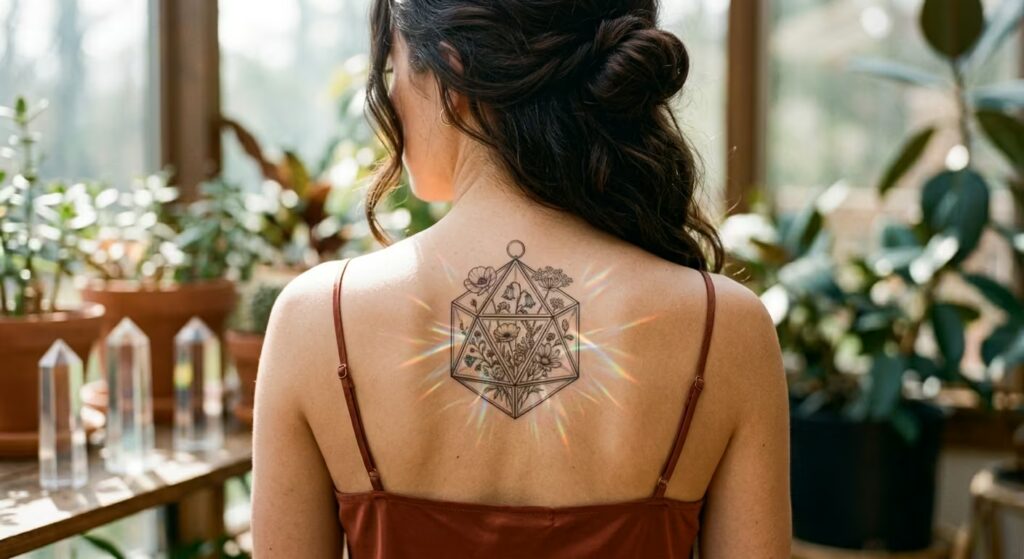
Poppies, bluebells, and daisies grow inside a faceted glass-lantern shape framed by sacred geometry. Wildflowers self-seed and resist being cultivated, so enclosing them in rigid geometry sets order against the things that refuse to be ordered.
This botanical tattoo reads as wildness held, not tamed. Sitting high on the spine, it faces the world rather than the wearer.
A circular forest-floor ecosystem on the back of the forearm Botanical Tattoo
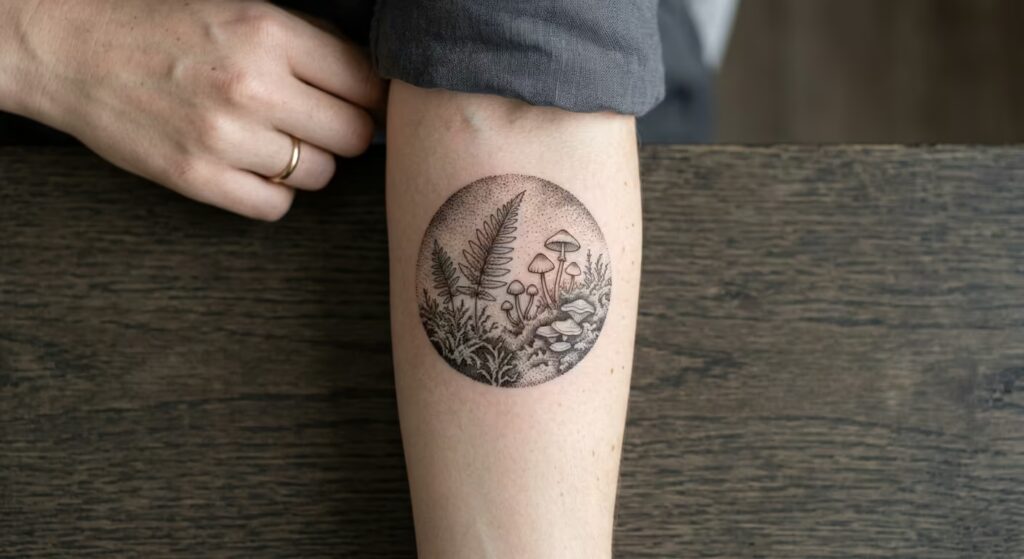
A coin-sized circle holds ferns, mushrooms, and moss in fine dotwork, like a slice of soil lifted whole. Fungi and ferns are decomposers and pioneers that thrive where flowering plants cannot.
The piece points to the unseen mycelial networks that connect a forest underground. The circle frames it as a small, self-contained world.
A trailing flowered vine wrapping the side of the neck Botanical Tattoo
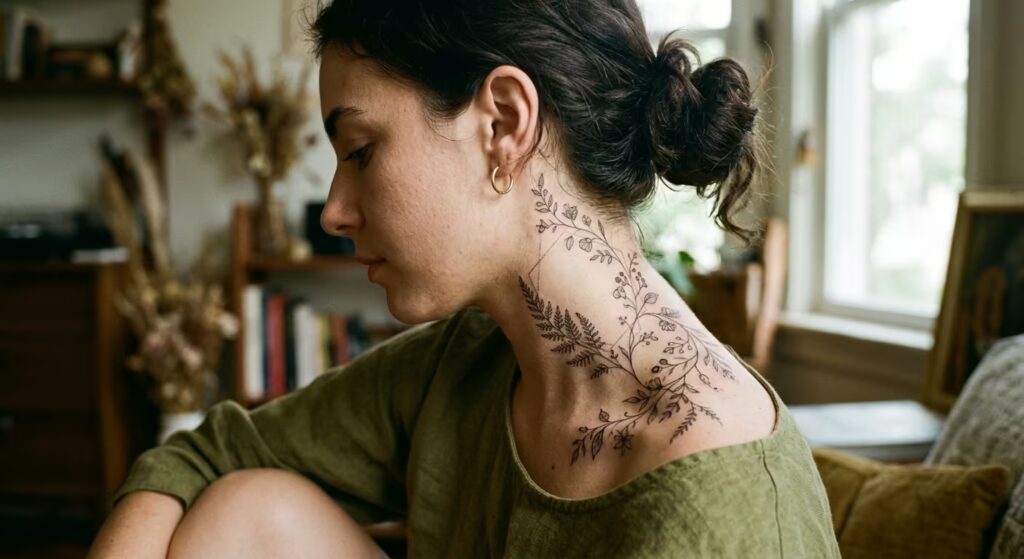
A delicate vine of tiny blooms and ferns climbs the neck, traced over a faint geometric line. Vines grow toward light and cling to whatever will hold them, so the design balances reaching with needing support. Neck placement makes it almost impossible to hide. It is a botanical tattoo choice that commits.
Two-layered leaves in an engraving style on the upper arm
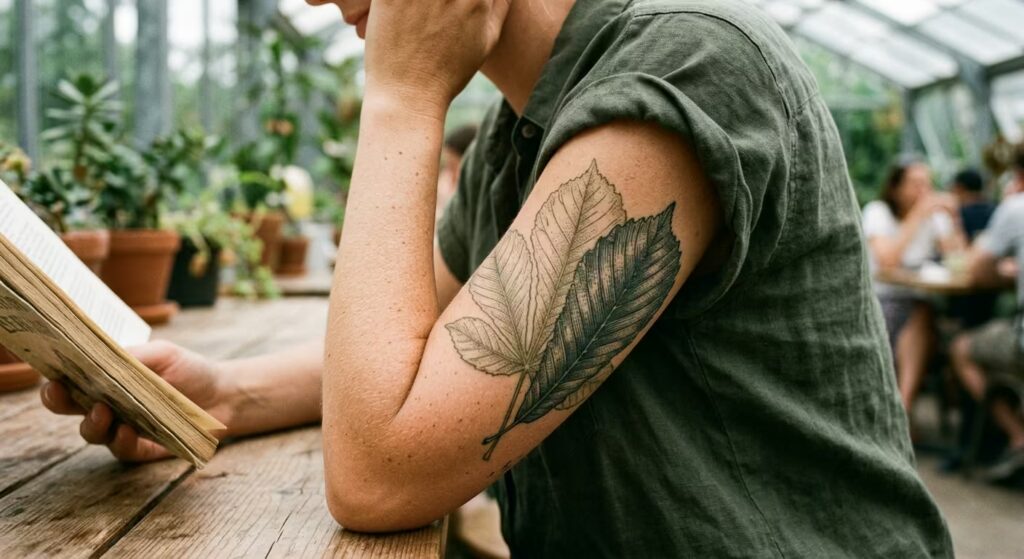
Two overlapping leaves are rendered in crosshatched, vintage botanical detail on the triceps. Leaves are the original symbol of seasonal release, turning light into energy before they fall.
A pair can represent two people, two chapters, or two sides of the same person. The aged engraving texture leans into memory and the passing of time.
A dandelion releasing its seeds across the collarbone Botanical Tattoo

A dandelion lets go of its seeds, which drift toward the shoulder in a thin trail. Dandelions are dismissed as weeds, yet they survive almost anywhere and spread relentlessly.
The plant reproduces only by letting go, which turns the usual wish-making symbolism into something sharper about release. The seeds crossing the collarbone make the body look as if it were caught mid-breeze.
A thorned botanical branch coiling the forearm in blackwork

A dark branch with serrated leaves and thorns spirals around the forearm. Thorns are defense, not decoration, evolved to keep the plant from being eaten.
The botanical tattoo design reads as boundaries and protection, beauty that does not invite careless handling. Wrapped around the limb, it shifts and flexes with the muscle.
Lavender sprigs lay along the inner forearm Botanical Tattoo
Slender lavender stalks run quietly up the forearm in a fine line. The name comes from the Latin “lavare,” meaning to wash, tying lavender to cleansing and calm since Roman bathhouses.
It was once sewn into pillows to ease grief and guard sleep. A restful plant in a restful spot.
A botanical-plate cosmos flower with its Latin name on the forearm

A single cosmos bloom is drawn like a page from an old herbarium, with its scientific name lettered beneath. The flower takes its name from the Greek “kosmos,” meaning order and harmony, reflected in its evenly spaced petals.
It stands for balance and wholeness, a small piece of the universe. The label treats the skin like a specimen page.
A bold peony cluster in blackwork on the forearm

Heavy, engraved peonies stack along the forearm in deep black shading. Across East Asia, the peony is the king of flowers, linked to honor, wealth, and, in Japan, to courage.
The botanical tattoo design speaks to a bold risk that pays off and to abundance that is earned. The dense black makes it legible from across a room.
A three-stage poppy across the shoulder and collarbone Botanical Tattoo

One poppy stem shows three stages at once: a tight bud, an open bloom, and a seed pod. The poppy carries sleep, remembrance, and memory, and its pod is the source of both opium and the seeds we eat. Showing the full cycle in a single stem is the entire point of the piece. It maps a whole arc of a feeling or a life.
A mushroom drawn from beneath on the forearm

A single mushroom is shown from below, every gill under the cap carefully lined. The mushroom is only the fruit of a far larger organism hidden in the soil. The botanical tattoo design argues that what is visible is a fraction of what exists, and that growth happens in the dark. It rewards the second look most people give it.
A wispy willow branch draped over the shoulder blade
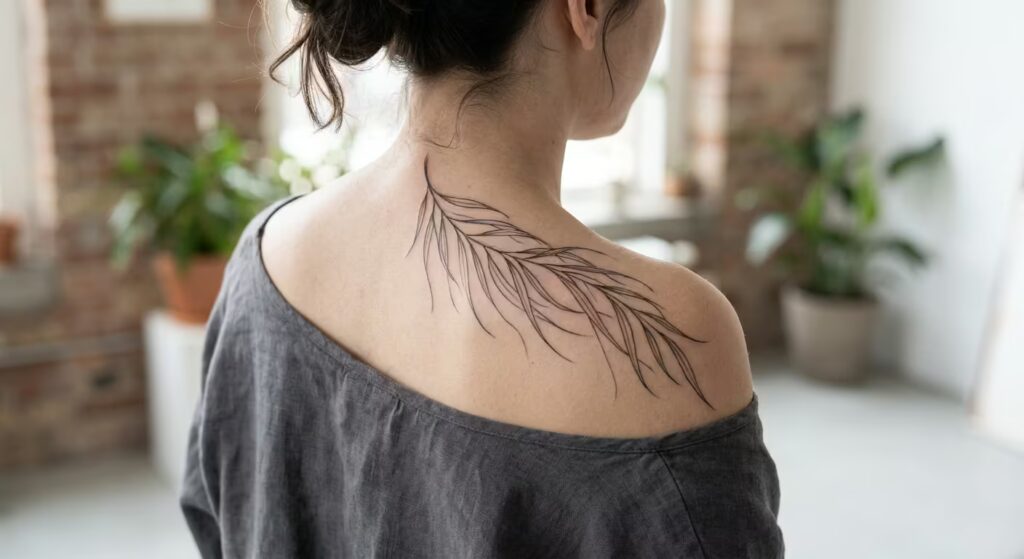
A thin, drooping branch trails across the upper back in a soft, fine line. The weeping willow bends in storms instead of snapping and can regrow from a single cutting.
It stands for flexible strength and for grief that survives and starts over. The drape follows the natural slope of the shoulder.
A sprouting seedling with deep roots running down the forearm
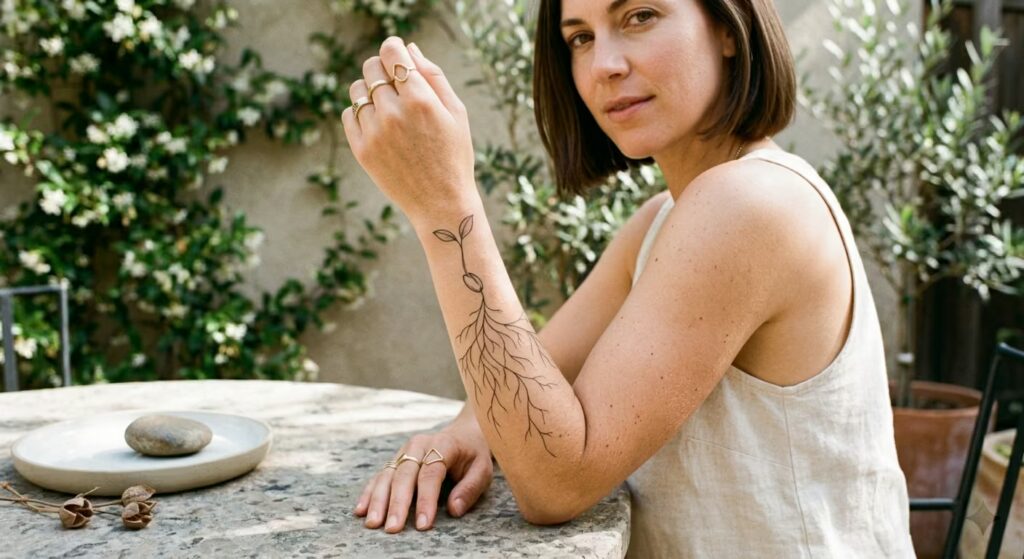
A two-leaf sprout sits near the wrist while its roots spread far down the arm, larger than the plant above. Most of a plant’s structure and most of its work happen underground, unseen.
The botanical tattoo design says you are bigger beneath the surface than what shows on top. It is a quiet argument for foundations over display.
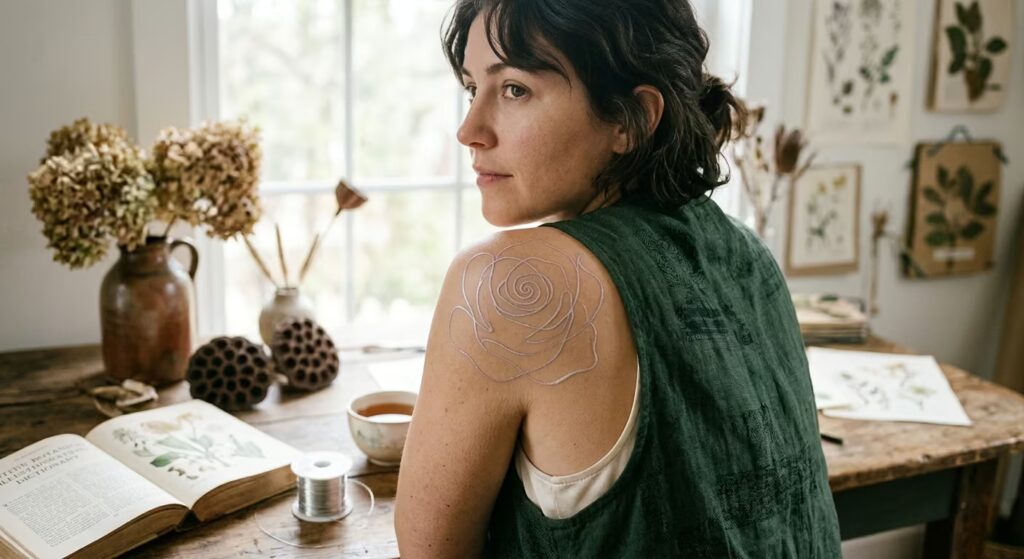
A single-line rose in white ink on the shoulder Botanical Tattoo
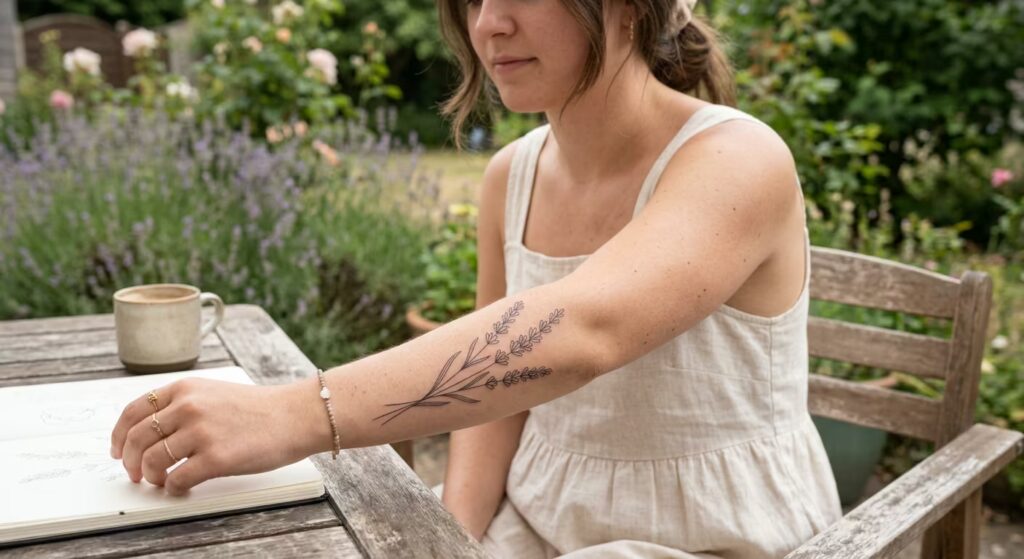
A continuous-line rose is tattooed in white ink, reading more as raised texture than as color. White ink fades and behaves like a scar or a whisper rather than a bold statement.
That makes it a private symbol, a love or a memory kept close to the chest. One unbroken line draws the whole flower without lifting the needle.
Blackwork ferns framing a flower cluster on the shoulder
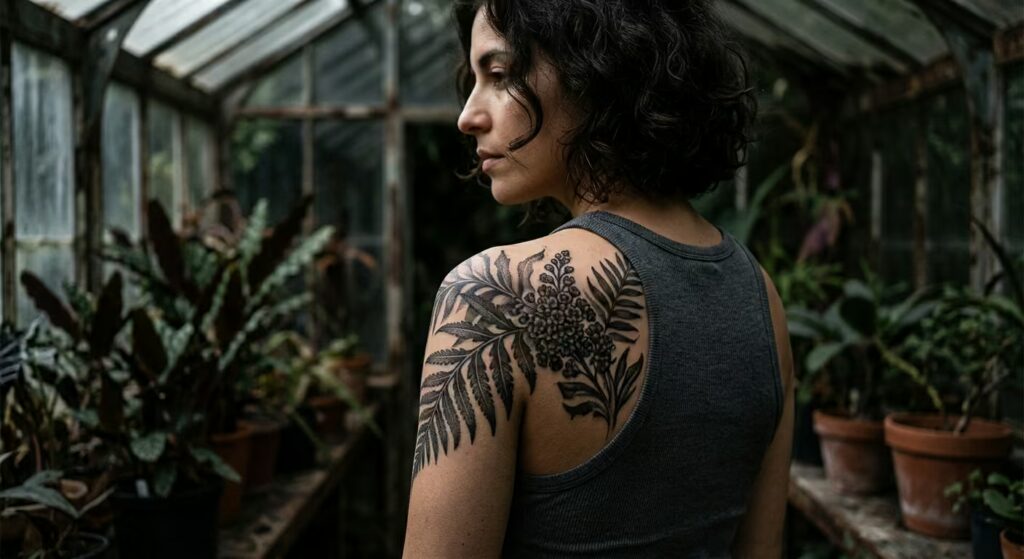
Dense, engraved fern fronds wrap around a tight cluster of small flowers across the shoulder. Ferns are among the oldest plants alive and reproduce by spores, predating flowers by hundreds of millions of years.
Pairing ancient ferns with newer flowering plants sets deep endurance beside fresh growth. The contrast is the meaning.
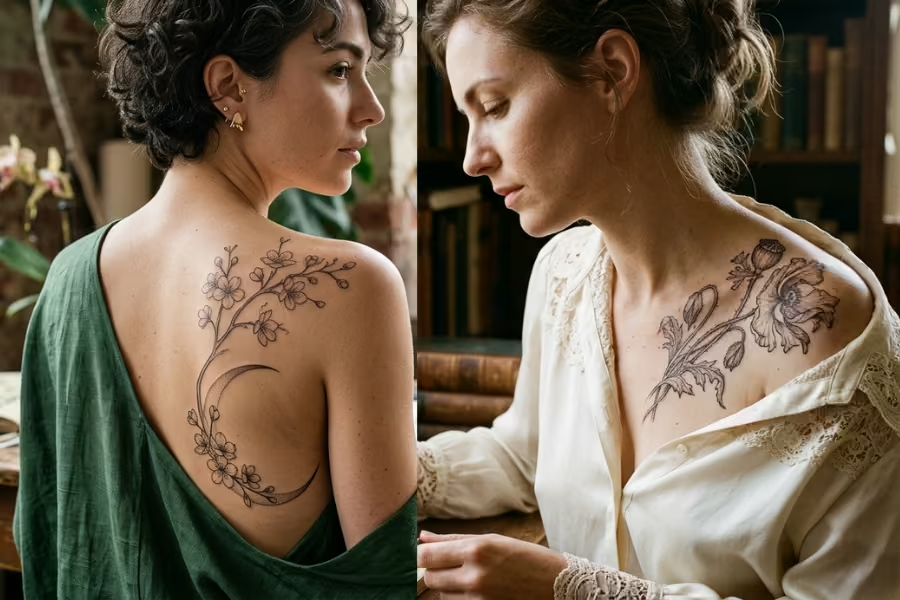
A cherry blossom branch curving into a crescent moon on the upper back
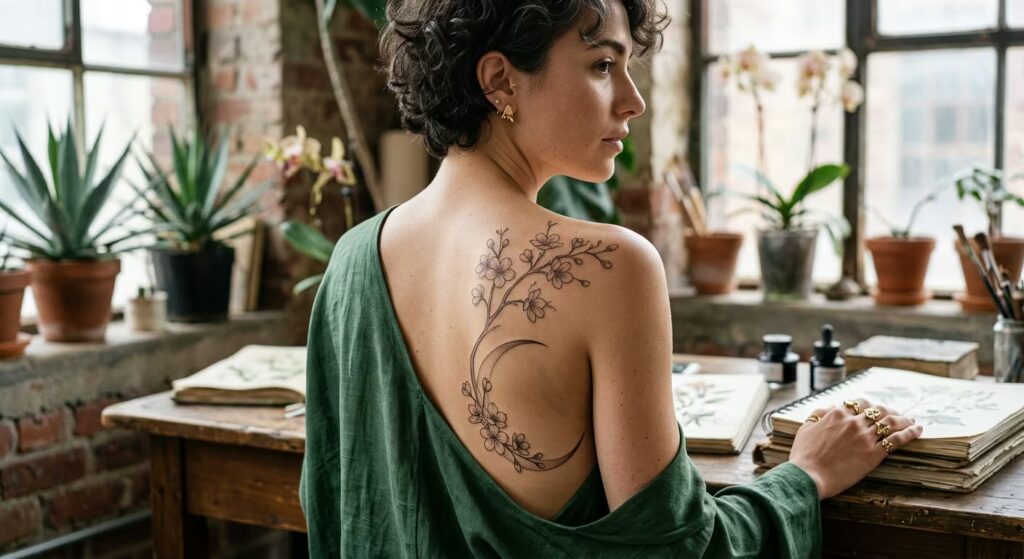
A sakura branch bends into the shape of a crescent moon between the shoulder blades. Cherry blossoms last barely a week, which is exactly why they are honored in the idea of mono no aware, the beauty of impermanence.
Tying the brief bloom to the moon links something fleeting to a cycle that always returns. It says cherish what is short, because it comes back.
A split-leaf monstera, half realistic and half geometric, on the forearm
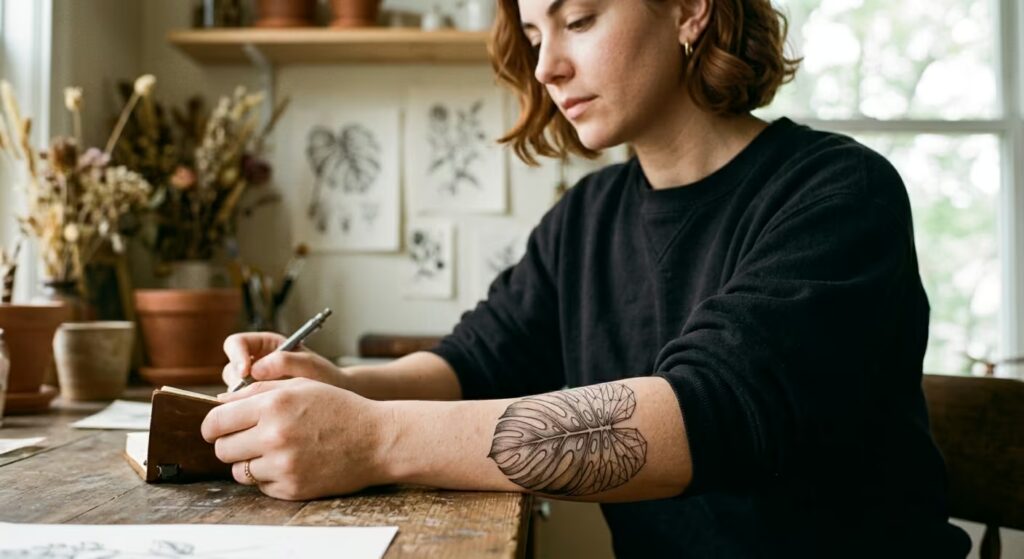
One monstera leaf is rendered two ways: detailed and organic on one side, clean geometric lines on the other. The natural splits in a monstera leaf let light reach lower leaves and let wind pass through without tearing.
This botanical tattoo design is about adaptation by design and about two ways of seeing one thing. The dual style is the statement itself.
A red spider lily along the spine of the lower back
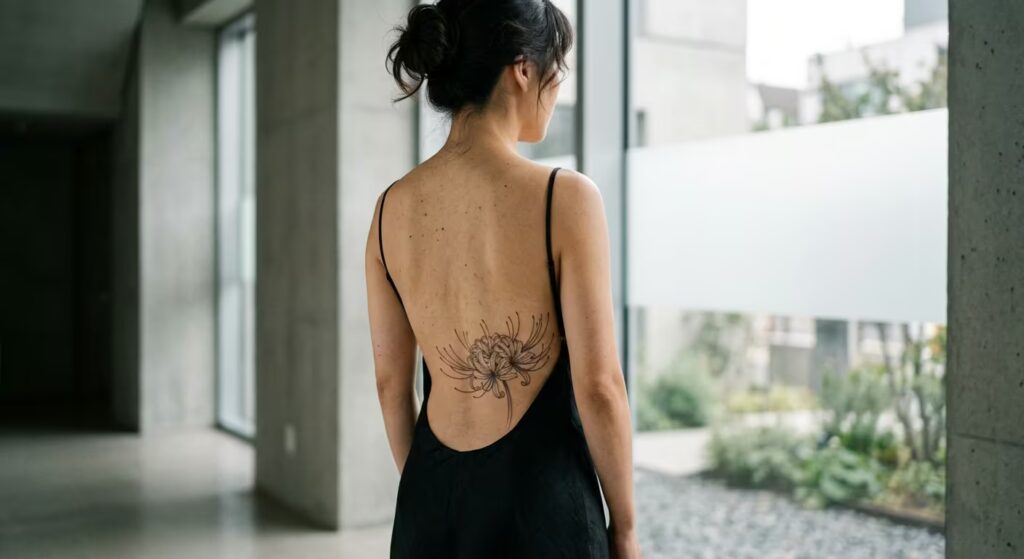
A fine-line spider lily with curling, thread-like petals runs down the center of the back. In Japan, the red spider lily, or higanbana, blooms near the autumn equinox and is associated with final goodbyes and the afterlife, and is often planted at gravesites.
It carries farewell and memory, and the belief that some partings lead somewhere else. Placing it along the spine aligns it with the body’s centerline.
A bold thistle in blackwork on the forearm Botanical Tattoo

A spiked thistle with a round purple-style flower head sits in heavy black on the forearm. The thistle is Scotland’s national flower, tied to a legend in which its spines pricked a barefoot invader and woke a sleeping army.
It stands for protection, defiance, and loyalty to where you come from. It is armor and a flower in a single plant.
A dotwork fern frond running up the forearm
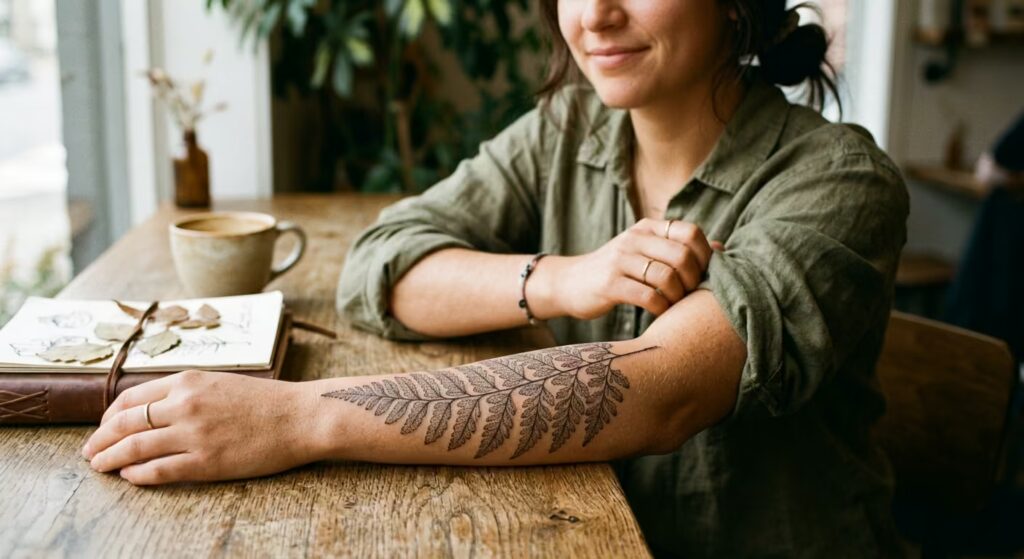
A single fern frond is stippled entirely in dots along the length of the forearm. Ferns unfurl from a tight coil called a fiddlehead, opening outward as they grow.
This botanical tattoo design reads as new beginnings and patient potential, the coil already knowing its shape before it opens. The dotwork echoes the spore patterns found on the underside of a real frond.